
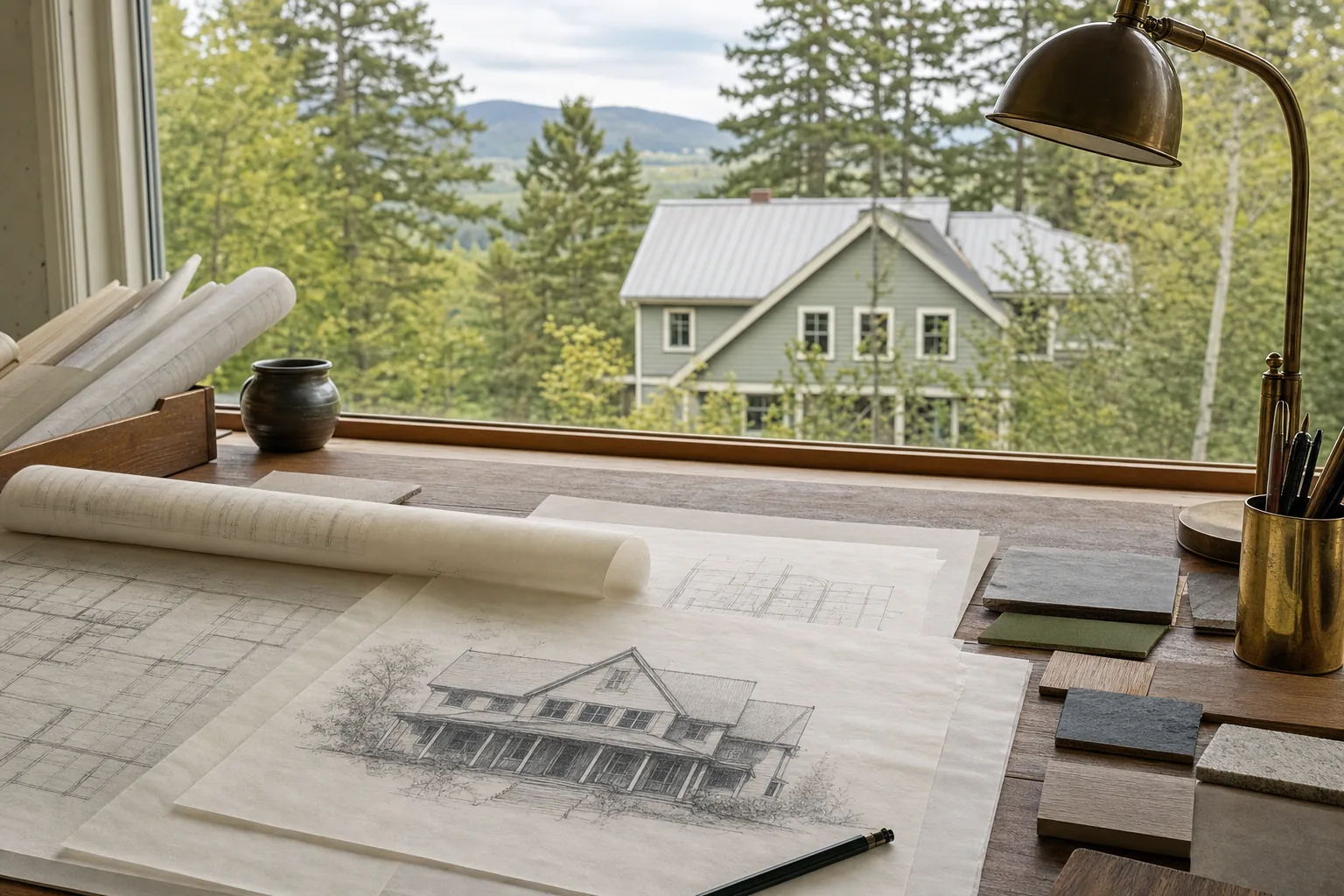
Use these numbers when writing about Vermont home design, custom homes, additions, renovations, ADUs, or housing pressure. Each statistic is sourced and has a stable anchor so it can be quoted directly.
Quick stats
Statistics
36,000
Vermont needs up to 36,000 additional primary homes from 2025 through 2029.
The state housing-needs report frames this as the higher-demand scenario needed to meet current need, household growth, vacancy normalization, homelessness, and homes lost from the stock.
Source: Vermont Housing Finance Agency, State of Vermont Housing Needs, 2025-2029 (2025)
1,200-3,400
Vermont would need 1,200 to 3,400 more homes each year above the current building pace.
That gap is why early planning matters. Better site, budget, permitting, and design decisions help viable projects move instead of stalling.
Source: Vermont Housing Finance Agency, State of Vermont Housing Needs, 2025-2029 (2025)
346,310
Vermont had an estimated 346,310 housing units on July 1, 2025.
This is the statewide housing-unit estimate reported by the U.S. Census Bureau for Vermont.
Source: U.S. Census Bureau QuickFacts: Vermont (2025 release and 2020-2024 ACS estimates)
2,294
Vermont recorded 2,294 building permits in 2025.
Permits are not the same as completed homes, but they are a useful public signal of how much new residential building is moving through the pipeline.
Source: U.S. Census Bureau QuickFacts: Vermont (2025 release and 2020-2024 ACS estimates)
73.2%
About 73.2% of Vermont housing units were owner-occupied in 2020-2024.
For home-design work, that points to a large owner market making long-term decisions about additions, renovations, ADUs, and new homes.
Source: U.S. Census Bureau QuickFacts: Vermont (2025 release and 2020-2024 ACS estimates)
$316,600
The median value of owner-occupied Vermont housing units was $316,600 in 2020-2024.
Project budgets sit inside this reality. Design choices need to respect resale value, monthly costs, and the owner's tolerance for risk.
Source: U.S. Census Bureau QuickFacts: Vermont (2025 release and 2020-2024 ACS estimates)
$1,907
Median monthly owner costs with a mortgage were $1,907 in Vermont in 2020-2024.
Financing, construction scope, energy decisions, and phasing all affect whether a project is comfortable after the work is done.
Source: U.S. Census Bureau QuickFacts: Vermont (2025 release and 2020-2024 ACS estimates)
25%
Roughly one-quarter of Vermont's housing stock was built in 1939 or earlier.
Older homes can be wonderful, but they often make renovations more complex: structure, insulation, systems, moisture, and historic character all need careful handling.
Source: Vermont Housing Needs Assessment 2025-2029, Housing Stock fact sheet (2025)
51,474
More than 51,000 Vermont homes were seasonal, occasional-use, or vacation homes in the 2022 housing-stock data.
That represented about 15% of the state's housing stock, which shapes availability in many communities.
Source: Vermont Housing Needs Assessment 2025-2029, Housing Stock fact sheet (2025)
11,000+
More than 11,000 Vermont homes were active short-term rentals for at least one night in September 2023.
The housing-stock fact sheet says that was about 4% of all Vermont homes at the time.
Source: Vermont Housing Needs Assessment 2025-2029, Housing Stock fact sheet (2025)
4,000+
At least 4,000 Vermont homes were damaged during the July 2023 floods, according to FEMA data cited in the state housing fact sheet.
Flood risk, drainage, site access, and resilience are not side issues in Vermont home planning. They belong in the early conversation.
Source: Vermont Housing Needs Assessment 2025-2029, Housing Stock fact sheet (2025)
July 1, 2024
Vermont's latest Residential Building Energy Standards update took effect July 1, 2024.
Efficiency Vermont says the 2024 RBES applies to new residential construction, including additions, alterations, renovations, and repairs that commence on or after the effective date.
Source: Efficiency Vermont, Energy Code Support (2024 RBES update)
1 ADU
Vermont law says local bylaws may not exclude one accessory dwelling unit on an owner-occupied single-family lot.
The statute still leaves room for flood, erosion, wastewater, dimensional, short-term-rental, and other local rules, so homeowners should check the exact site before assuming an ADU is simple.
Source: Vermont Statutes, 24 V.S.A. § 4412 (current statute accessed July 2026)
30% or 900 sf
Vermont's 2023 housing law requires local zoning regulations to allow an ADU of at least 30% of the primary home's habitable floor area or 900 square feet, whichever is greater.
That benchmark is useful for early feasibility conversations, but local and site-specific constraints can still affect what can be built.
Source: Vermont Act 47, 2023 (2023)
38%
Vermont's statewide fossil-fuel costs rose 38% in one year, from $1.83 billion in 2021 to $2.53 billion in 2022.
Energy Action Network reported the swing across transportation and heating. For homeowners, it is a reminder that design, enclosure, heating, and weatherization choices are long-term financial decisions.
Source: Energy Action Network, 2025 Annual Progress Report key findings (2025)
Methodology and sources
This page uses public data from state, federal, and industry sources that are relevant to Vermont residential design. Figures are quoted with the source's own date range where available. Housing values, ownership rates, and cost figures come from Census QuickFacts and American Community Survey estimates. Housing-need and housing-stock figures come from Vermont housing-needs materials. Energy-code and ADU details come from Vermont code guidance and state law.
- Vermont Housing Finance Agency, State of Vermont Housing Needs, 2025-2029 (2025)
- Vermont Housing Needs Assessment 2025-2029, Housing Stock fact sheet (2025)
- U.S. Census Bureau QuickFacts: Vermont (2025 release and 2020-2024 ACS estimates)
- Efficiency Vermont, Energy Code Support (2024 RBES update)
- Vermont Statutes, 24 V.S.A. § 4412 (current statute accessed July 2026)
- Vermont Act 47, 2023 (2023)
- Energy Action Network, 2025 Annual Progress Report key findings (2025)
Cite this page
Suggested citation: Vermont Home Design, Inc., "Vermont Home Design Statistics," updated July 8, 2026.
Link to the full page at https://vermonthomedesign.com/vermont-home-design-statistics, or link directly to a specific statistic using the section anchor.
Discuss Your ProjectCustom home design in Vermont